Enter your keyword

Posts mit dem Label Ohrid werden angezeigt. Alle Posts anzeigen

Mittwoch, 28. März 2018

Ohrid Lake recreational fishing attractive to tourists

On März 28, 2018

Alternative tourism is becoming an increasingly important part of the global tourism market. Statistics show that people are losing interest in vacation packages, preferring to fill their holidays with various unconventional activities instead.

In keeping with worldwide trends, Ohrid, Macedonia’s most famous tourist destination, has started to offer active forms of tourism, including mountain climbing, cycling, paragliding, and scuba diving. Lately, however, recreational fishing trips have become one of Ohrid’s most popular attractions.

Ohrid native Ljupcho Stojkoski-Lepi is a passionate angler, outdoorsman, and fishing guide who has successfully introduced sport fishing as one of the alternative tourist activities the town has offered in the past three years.

Stojkoski has tried to actively incorporate his experiences from Germany and the Netherlands into his promotion of recreational fishing at Ohrid Lake. He offers tourists a unique way of enjoying the lake’s natural beauty while catching fish.

“A large number of tourists bring their fishing equipment to Ohrid,” Stojkoski says. “I organize day trips on the lake, providing experienced fishermen and amateur anglers with everything they need to catch fish – from transportation and equipment to access to the best fishing locations, whether for shore fishing or open-water fishing.”

Foreign visitors who decide to catch fish at Ohrid Lake are usually recreational fishermen and outdoor enthusiasts. Most of them release the fish they catch, but there are those who want to keep their fish. The organizer provides all of them with a fishing license that allows them to both fish and to keep some of their catch (up to 5 kg per person, or up to two fish if they happen to catch Ohrid trout).


Best of all, anglers can opt to take their catch to an interesting locale, such as a picnic area or a restaurant, where they can have the fish prepared using traditional local recipes, or in their own preferred way.

Many visitors have taken recreational fishing tours at Ohrid Lake, including tourists from the Netherlands, Germany, Poland, the Czech Republic, Norway, Hungary, Italy, neighboring Balkan countries, and even China.

“Depending on the kind of fishing they opt for, tourists can fish from fishing boats, various lakeshore locations, or local fish ponds,” Stojkoski says.

“Some of them prefer to catch the fish that will be their dinner. The positive feedback from the fishing tours confirms that recreational fishing deserves its place among the activities Ohrid offers.”

When it comes to Ohrid Lake fishing, it truly is a unique experience for tourists.

“Catching chub from a boat can rival open-sea fishing since we fish at depths of 20-30 meters. The lake’s clear water, combined with beautiful weather and picturesque surroundings, offers a truly unforgettable setting that, as many tourists have said, cannot be put into words, but can only be experienced.”


Surprisingly, however, Ohrid travel agencies have shown little interest in offering this type of recreation. Even worse, according to Stojkoski, some agencies have tried to improvise unprofessional fishing tours, which risks leaving tourists with a bad impression. Stojkovski adds that hotels along the Ohrid riviera, fortunately, take a more serious approach, recognizing the potential benefit from expanding the recreational activities they offer visitors.

Stojkovski is trying to incorporate recreational fishing into the town’s tourist offerings by suggesting it be advertised alongside the town’s attractions at tourist fairs, even if it means simply distributing brochures.

There is no doubt, however, that the best advertising is word-of-mouth. For example, positive feedback and comments from Dutch anglers resulted in Ohrid Lake’s recreational fishing being mentioned in a specialized fishing magazine in the Netherlands a few years ago. Now, a number of Dutch tourists have already booked recreational fishing tours at Ohrid Lake for their next vacation.

Aleksandar Bachikj
Translated by Magdalena Reed

Sonntag, 22. Oktober 2017

Ohrid: A medieval town in search of its roots in the 21st century

On Oktober 22, 2017

Ohrid is a stunning medieval Ottoman town on the shores of a mountain lake. The old town drags and clambers all over the hills behind the lake. Terraced cobblestone avenues run between tall, narrow houses, and age has tinted the facades of the buildings so the whole city looks tea-stained. We got lost in the flower-strewn corridors of the old city. We saw a church of dusty brown stone which looked like a dribble castle. We swam in the cold blue of the lake and walked along the beaches.

We went to cafes in the public square in the morning, and we went dancing at a club on the docks at night. We stopped at a café in a stone house which had been a private mansion until it was sold in the 80s. And, while searching for the bus station in the new part of town, we walked through a rustic village and saw a fat brown bulldog lounging on a porch behind a custom-made BEWARE OF DOG, which portrayed the same fat brown bulldog sitting on that same porch in the same pose. Ohrid is a beautiful old Ottoman town in a crater lake in a geographic nowhere and I love it.

Most of what I learned about Macedonia, and the town of Ohrid, happened over a plate of kebab, and came from a Slavic-origin dog enthusiast from New York.

We were walking down the square in Ohrid away from our hostel when a man in a dirty gray t-shirt saw our dog and came over to pet it. His wife, smoking spindly cigarettes, descended on the dog in a frenzy of sweet words, cuddles, and cooing. The guy, Kosta, was from Brooklyn, but his parents were Macedonian and he had partially grown up in Skopje. He recommended a kebab place called "Delicious" (Fkuzna), the thought of which apparently made him so hungry that he and his Slovenian wife came with us and ordered for us. We got Macedonian kebab, called "cevap," tiny logs of meat served with amazing grilled bottle-green peppers. Kosta said that he and his wife visited last summer for about two months and kept meaning to try other restaurants, but they just kept coming back here, every day. This was their favorite restaurant in Europe, maybe the whole world which meant that they ate ten tiny meat logs every day for like two months. Fkuzna.

Macedonia, or the Former Yugoslav Republic of Macedonia (FYROM), was the last state to break away from the former Yugoslavia. The name itself comes from the region of Europe they're in, Makedonia (with that hard k sound), but even that's controversial as it is also the name of a region in northern Greece. This is why when they entered the United Nations, they had to pick a name that wouldn't make Greece upset, hence the somewhat off-center acronym of FYROM.

Ohrid: A medieval town in search of its roots in the 21st century

Secondly, they have a bit of an identity crisis, since their language and the Bulgarian language are mutually intelligible, for the most part. Bulgaria used to have this big ol' kingdom in the middle ages which included modern-day Macedonia. The city of Ohrid was an ancient capital of the kingdom, and Bulgarians still feel like it was stolen from them by the Macedonians, who are certain that it was the Bulgarians who'd usurped the just Macedonian king from his throne. You see how complicated this stuff is.

Macedonia as a nation has this need to distinguish themselves. Though most Balkan countries feel a deep need to assert their nationalism, organized around a heroic figure, Macedonia most recently started playing this game, as they only became a republic in the nineties. Out of this great need for a national pride, in Republic Square in Skopje, a colossal gold Alexander the Great rises out of the earth on a pillar, surrounded by phalanxes embossed into the pillar's base, obscured by a spray of mist from the fountain. When people ask, hey, what's Macedonia? Anyone in the country can say, "Take a look at that enormous pillar."

When we first arrived in Ohrid we noticed none of this nationalism – just a lot of history concentrated in one beautiful spot. It was a bit too late to start sightseeing, so we dropped our things at Sunny Lake Hostel and headed to Çınar restaurant in the Turkish quarter for some kebab. Cinar, for our non-Turkish-speaking readers, means "Sycamore," and an enormous Sycamore tree was rooted in the cobblestone roads, sheltering the outdoor tables at this restaurant.Before being a suburb for rich Turks, Kosta informed us while as were sitting down for meat logs at Fkuzna the next day, Ohrid was a Slavic university town from the middle ages which has 365 churches, actually literally truly one church for every day of the year. Good Christians would actually visit a different church for every day of the year in a peculiar keeping-up-with-the-Joneskis medieval contest. The Cyrillic alphabet was invented here, at the University of Ohrid, by a couple of monks who felt the Greek alphabet was inadequate to describe the liturgy in the Slavonic dialect of the time.

Ohrid: A medieval town in search of its roots in the 21st century

Lake Ohrid is nestled in a hollow between the mountains. If you walk around the lake, you can see the ridges extending far into meadows where you will never walk. From the old town, a boardwalk runs along the side of the lake bolted to a sheer rock wall, and then the trail goes up past a ruined church – the Church of Sveti Jovan (St. John). This is probably the most photogenic building in the whole town. It's easy to see why: against the backdrop of the plaintive blue lake and low sloping mountains, a series of bricked octagons topped by a zigzag tile roof cuts into the horizon. Inside, if you want to pay the 100 Macedonian Dinars as admission ($2) you can peep at all the icons.

Past the church, then into the woods, a trail runs down onto a secluded beach. This was a premium spot, as nobody was there, though we did find a nearby hobo shack and broken refrigerator which had last been used to store hundreds of thousands of spiders. The scenery was ethereal.

Felix, a Swiss guy from our hostel, and I got into the water. I dived in, but jumped out soon afterward because it was too cold. Felix said "You have to meditate into it," and waded in, centimeter by logical centimeter. Cassidy, a Canadian EMT with a probably-not-coincidental zest for life, arrived late and leaped into the lake, and said Woo! Let's swim to that cave over there. His vitality was inspiring and we followed. It is an attitude I wish to emulate: take enormous leaps and then follow them through. But the water was icy: we swam and it was like swimming through crude oil. I had to keep moving to stay warm. Every time my head dipped beneath the fresh clean water, the mountains would disappear, and then reappear back into view.

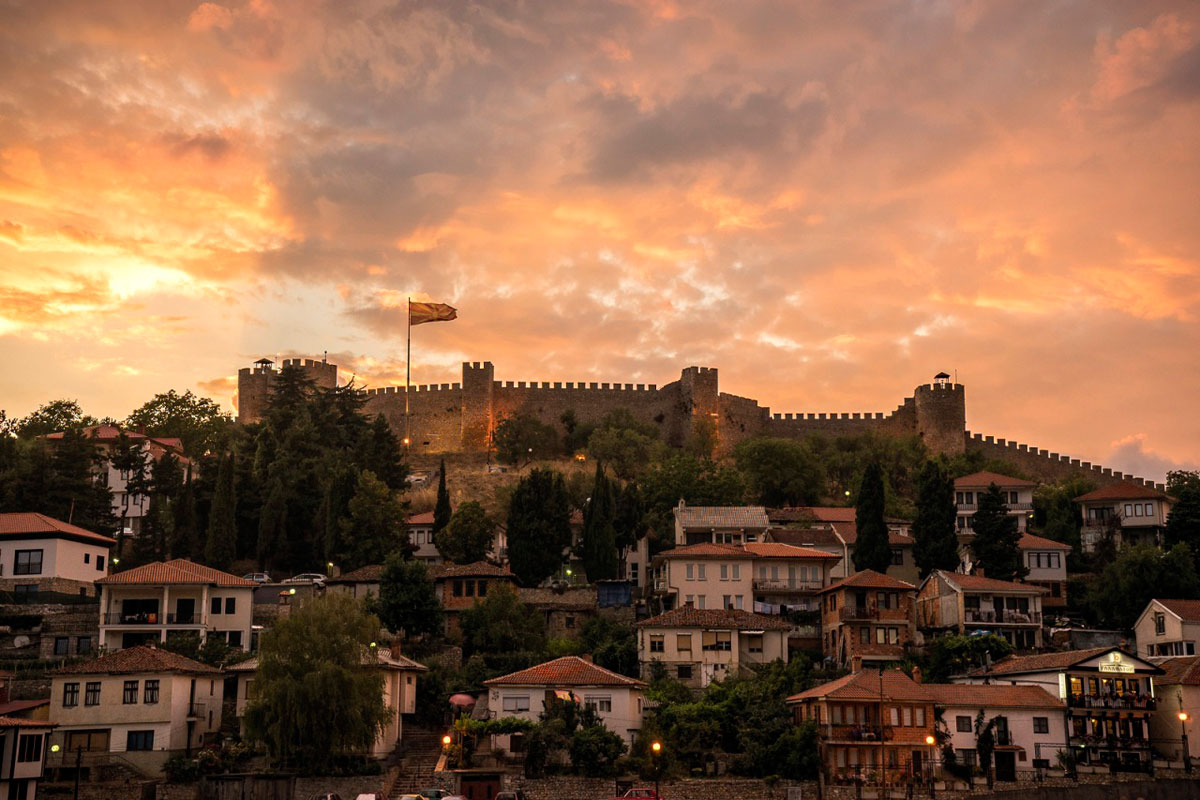
Then, it was time to towel off and head to Samuil's Fortress, towering above the town. You haven't looked behind you yet? Oh, be careful, because you might get crushed by the shadow of Tsar Samuel's walls. The 11th century was a good time for the Macedonian kings. They had enough money and territory and rocks to build an impressive skyline, most of which still lines the background of any photos you might want to take.

Just below the fortress by the shores of the lake is the Plaosnik church and archeological complex. The church dates from the 4th century, and it's surrounded by the stubby walls common to enormous monastic compounds of the past. This one used to host 3,500 scholarly monks. Most weirdly, one of the mosaics on the floors of the compound features a swastika. It didn't mean anything bad back then! It was a good luck symbol! (Though, I was a bit perturbed by the graffiti swastikas on streetlights outside of town.)

After you've hit up the big names in Slavonic churches, I strongly recommend you spend the rest of the afternoon just strolling past the chunky wooden houses and along the cobblestone roads of the old Ottoman town. There aren't nearly enough gorgeously-preserved Ottoman cities in Europe, with the clean white walls and brown wooden trim of their domiciles, and every time I find myself inside them I feel a great warmth towards the many craftsman who built these houses for the Balkan middle class several centuries ago. Today, you can either rent apartments from the locals or eat in their restaurants – as in most Balkan countries, the residents of antique houses have figured out that they can rent their restored flats out to tourists for as low as 25 Euros a night. Monks in the 11th century probably paid a bit less, but you at least get to order as many meat logs as you can eat. Fkuzna.

SOURCE: DAILY SABAH

Sonntag, 1. Oktober 2017

Why you should visit Ohrid in winter

On Oktober 01, 2017

The Ottoman houses on the shore of the lake are veiled in the morning mist, as if they were white ghosts against a blanket of white. This enveloping whiteness hovers over the wooden boats scattered around the lake and swallows the crown of houses ranged around it. Nevertheless, I know how beautiful the view is, having seen countless postcard-perfect pictures of this UNESCO-listed lake, which is one of the oldest in the world.

Ohrid in winter
When tourists are gone and winter is in the air, Ohrid becomes again the picturesque lakeside town that has enchanted visitors since the Byzantine Empire.


The pale light of the sun reflects on deserted cobbled streets, and this glowing fog melts in time with the footfalls of the few people wandering around.

The ancient stones drenched with rain emanate a wet, winterish smell, which –here and there- is abruptly interrupted by the warm smell of oven-baked bureks. The churches are scented with incense. Ohrid is well-known for its churches, which were 365 originally –one for each day of the year- a feature which won it the epithet of ‘the Jerusalem of the Balkans‘.

Ohrid’s churches, as well as its architecture, span more than two millennia, but this is just one of the reasons why this enchanting city is recognized by UNESCO. Actually, it is one of the 28 UNESCO World Heritage Sites that are on both the Cultural and the Natural lists.


I didn’t stumble upon any celebrations inside Ohrid’s churches. Rather, I always found a profound silence only occasionally interrupted by footsteps tiptoeing on the marble floorings: a solemn atmosphere I bet you can only find during this time of the year, when the town becomes quiet and idyllic again.

Unlike with my usual ‘travel-style’, I visited a lot of churches when in Ohrid, starting off with an ambitious plan in the early morning, but then slowly adopting a more Balkan approach as the day passed by. This implied Turkish coffees, Skopsko beers, some meaty snacks and the ubiquitous Ohrid trout, which is the protagonist of the traditional cuisine of the area and the only thing that the Macedonian shore has in common with the Albanian side across the lake.


The area is also well-known for its centuries-old tradition of wine making. Macedonians love to drink, and Ohrid’s porches overlooking the lake are the perfect place to do it. During the summer, all these lakeside cafés are bustling, but now the paved promenade is empty and everything looks more authentic.

Even the accordion player at a fancy restaurant goes for Tose Proeski’s very Macedonian songs rather than the international repertoire of the summer. When the music stops, the only sound I can hear is the rhythmic percussion of waves on sand.

As I watch them coming and going, I can’t help thinking about the time when I was on the other side of the lake, on the Albanian shore. The two experiences could not be more different: the touristy, postcard-perfect Macedonian outline of the Ottoman houses and the rough, neglected jumble of concrete on the Albanian side.

Anyone who has visited both sides of Ohrid Lake knows that these two landscapes are not a just lake, but a whole world apart.


Donnerstag, 24. August 2017

The National: Cooling off in Macedonia's Lake Ohrid

On August 24, 2017
Tom Allan travels to Macedonia and explores the landlocked country's spectacular lake and layered history 

The Italian media called it ‘Lucifero’. The heat has buckled train tracks in Serbia while in Macedonia wild fires rage on the hills around the capital, Skopje, filling the sky with an orange haze.


Lake Ohrid, in the south of the country, straddling the border with Albania, offers a refreshing refuge from the heatwave sweeping southeast Europe. A trip to its clear, cool waters and pebble beaches is an annual ritual for landlocked Macedonians.

"This is the closest we have to the sea," explains a woman on the winding bus journey from Skopje. "I live in Canada now, but still try to come back each summer."

The lake is busiest in July and August so if you come then, expect beach parties and jet-skis as well as Byzantine churches, Ottoman architecture, and one of the most unique ecosystems in Europe.

"The best time to visit is September, or early summer," says local guide Misho Yuzmeski the next morning, as he takes me on a walking tour of the old town of Ohrid, the largest on the lake and my base for the week. "It’s much more peaceful then".

Yuzmeski – writer, translator and fluent in eight languages – is an inexhaustible source of knowledge on his home town.

"However hot it gets, there is always a breeze in the old town", he says as we gaze down over the red tiled roofs and twisting cobbled streets, over the 36 kilometres of silky water and beyond, to the Albanian mountains. Right on cue, a cooling wind springs up, taking the edge off the midday glare.

Ohrid has, to borrow Homer’s phrase, a climate ‘where life is easy for men’. It is one of Europe’s oldest settlements: there are remains here from the 4th century BC. That’s modern compared to the lake itself, which at over a million years is one of Europe’s oldest.

Thanks to its age, Lake Ohrid has more endemic species per square metre than any other lake in the world, according to Unesco. The most famous of these is the Ohrid trout, said to have a taste somewhere between brown trout and Atlantic salmon. It’s now critically endangered and fishing is controlled on the Macedonian side of the lake, so the trout on Ohrid restaurant menus is mostly farmed.

The first thing you notice about the lake is the clarity of the water. This is paradise for a swimmer like me: the white pebble beaches, ochre cliffs and glass-clear water are more like the Adriatic than an inland lake.

Yulvan Sekuloski, who works in the Amfora Dive Centre, 16km south of the town of Ohrid, explains that this is one of the clearest lakes in the world. The springs feeding it filter through the limestone fissures of the Galičica mountains, giving a visibility of up to 22 metres.

"I have dived all over the world, and no fresh water systems compare to here," Sekuloski tells me. Divers shouldn’t miss the chance to explore the remains of the Neolithic stilt-house village in the Bay of the Bones.


These natural splendours are matched by Ohrid’s cultural and religious heritage. For fans of Byzantine churches, this is heaven. Even a non-aficionado can’t fail to be impressed by the frescoes in St. Sofia church, still full of expression and life after 900 years, or the magnificent paintings in the icon museum.

The sheer number of churches has given Ohrid the name ‘the Jerusalem of the Balkans’, though Yuzmeski dismisses the often-repeated theory that there are 365, one for every day of the year.

"That’s something the other guides like to tell people. I don’t know how many there are but not 365!"

One thing is clear though: things in Ohrid are changing. We walk on past the Roman amphitheatre to a hilltop with spectacular views over the lake – and of a string of hotel complexes on the far shore. Once the hill was covered in pine trees and layers of Roman, Byzantine and Ottoman ruins. Now a major construction project is underway, bearing the unwieldy title 'The Instauration of St. Clement’s University at Plaoshnik’.

St. Clement was a disciple of Cyril and Methodius, the two hoary brothers from modern-day Thessaloniki who invented the Cyrillic alphabet. Clement founded a university here in the ninth century and from this hillock above the lake spread the new script throughout the Slavic world. The church bearing his name has been faithfully rebuilt, with new visitor- and study centres also under construction. "They have built the church beautifully," says Yuzmeski. "But the rest, it’s too much," he continues, pointing at the complex of buildings that will soon dominate the skyline.

‘Too much’ could be applied to other government projects in Macedonia. The infamous ‘Skopje 2014’ initiative saw somewhere between $250 and $650 million spent on gargantuan bronze statues in the capital – money, critics argue, that a poor country like Macedonia can ill afford.

The government has other plans for Ohrid, too: a 30,000-capacity ski resort in the mountains of Galičica National Park and further hotel developments along the lake shore. Unesco has warned that it will review Ohrid’s World Heritage status unless the more contentious proposals are dropped.

Macedonia, with the fifth lowest GDP in Europe and 23 per cent unemployment, badly needs tourism. The new Social Democrat government elected in June on a pro-reform, anti-corruption agenda have pledged to review all development that threatens the integrity of the lake.

"Our goal is to develop sustainable and responsible tourism by focusing on the local, authentic experience […] and all the adventure possibilities this area has to offer," government spokesman Mile Boshnjakovski tells me via email.

The government also plan to invest in new cycling and walking trails along the lake shore, he adds, improving access with minimal damage to the environment.

But with a slim majority in parliament and the daunting task of overhauling the country’s institutions ahead, this is far from assured. Yulvan Sekuloski from the dive centre strikes a final note of caution. "If carefully planned the wildlife and the lake could be preserved. But unfortunately there is a lot of damage done already. If it continues at this pace I think the future will not be so bright."

On my last night I speak to a young German couple, who tell me about a ‘performance art’ event they saw in the St. Sofia church the night before.

Part of Ohrid’s Summer Festival, the evening featured techno, UV lights and a male stripper. The 11th century frescoes must have blushed.

This evening the Optina Pustyn monastery choir from St. Petersburg perform. The closest we get to techno is the floor-trembling voice of the basso profondo, reaching depths that only Russians can, but the heat inside St. Sofia’s thick walls wouldn’t be out of place in a rave.

Shirts stick to the backs of chairs, programs are fanned and the choir look close to heatstroke in their black robes. As we empty out into the muggy night a honey-yellow moon rises over the Galičica mountains, casting an avenue of dimpled light across the lake. The soft lights of a nearby cove beckon. It’s time for a final swim.

SOURCE: THE NATIONAL

Dienstag, 15. August 2017

Radozda between sunrise and sunset - Travel Macedonia

On August 15, 2017
Lake Ohrid at sunrise, Jablanica mountain at sunset. In between, one of the most beautiful places at the Struga shore - Radozda.


A fishing village from the beginning of times. Presently, a tourism oasis, a destination for those seeking peace and tranquility, a rest for the body and soul.

People here lived from fishing, but also manufactured dinghies and boats, winches and fishhooks. Radozda villagers were masters of the craft of which they are still proud.

As time went by, it became difficult to live just off fishing and people started to emigrate. Families went to America and Australia, some in Europe, others in the region, but also across Macedonia. But they never forgot whey they come from.


Radozda is known for its hospitality, seen in its motels, restaurants, bars, but also the accommodation that offers a pleasant stay on the shores of Lake Ohrid, under the shade of Jablanica.

Radozda is situated on the western shore of the Ohrid Lake. It is 10 km south of the town Struga and 2 km from the Macedonian-Albanian border. The village is situated at 725 m above sea level.

A document from the era of Tsar Stefan Dusan has the village listed under the name Radobuzda. An Ottoman document from the year 1583 also records the village but under a different name Radohozda while a hand written document from the Serbian Branislav Nusic has the village listed as Radoozdz and Austrian-Hungarian maps have the village listed as Radoliozda or Radohozda.


The village has seven churches, the main one being St.Nicholas, built in the 18. century, while cave church Saint Archangel Michael dates back from the 14. century.

Another trait of the village is the preserved section of the Via Egnatia road, constructed by the Romans in the 2nd century BC. About a hundred meters of the road has been maintained by the local population and dubbed "kaldrma" (cobblestone).

By Keti Mickovska

Sonntag, 13. August 2017

Rock Jumping Trpejca Lake Ohrid Macedonia

On August 13, 2017


Awesome clip from Macedonia, lake Ohrid. Some guys taking the rocks and so,e jumping in the clear and deep waters of lake Ohrid near Trpejca.


Donnerstag, 10. August 2017

Ohrid: The Jewel of Macedonia

On August 10, 2017
Ohrid is the reason to visit Macedonia.

The town is located on the shores of the aptly named Lake Ohrid and has a wonderful mix of natural beauty and historical monuments to keep you occupied for a few days.


I took the 3.5 hour bus to Ohrid after visiting Skopje of which there are several buses that run throughout the day. Upon checking in to Sunny Lake Hostel, run by the very friendly Gyoko, I instantly felt at home as the place is another reminder of the famous Balkan hospitality. In a lot of ways, you feel that he is running this place as if he was just having a constant stream of his friends over as he offers guests beers, tips on where to go and free use of the bikes despite the sign above reception suggesting they cost €5 per day.

On my first day, I followed a walking route that Gyoko recommended which took in the main sites of the town. I started by making the short but relatively steep walk to King Samoil’s Fortress which, like most fortresses, offers brilliant views of the surrounding area. The beauty here though is further exemplified due to the gorgeous lake and surrounding mountains.

The route then follows through the Old Town Park to the Early Christian Basilica and Saint Pantelejamon – the site of the oldest university in Europe and birthplace of the Cyrillic alphabet. The area has changed between having churches and mosques built depending on the ruler of the time and they are currently reconstructing a church in the area.

The highlight, however, of my walk was just around the corner as I came across the Church of Saint John the Theologian. The small church is stunningly built on a cliff overlooking the lake and is certainly one of the most scenic locations for a church that I have come across during my travels in the Balkans. It was the perfect spot to sit down and people watch as I admired the full beauty of the lake and cliffs.

The rest of my walk passed through some small sandy beaches and a couple of other significant churches – the Saint Sophia and the Saint Bogorodica Perivlepta before taking me back to the main boulevards which are lined with restaurants, boutique shops and cafes. My favourite spot was the small family run business of Dr Falafel whose menu of falafel, hummus, or falafel and hummus is simple but incredibly tasty and a rare vegetarian option.

On my second day, I made use of Gyoko’s generosity and took a bike out to ride around the lake. Not having much of an itinerary in mind, I rode west along the lake’s banks and within a kilometre, I was outside the built-up areas of the town and could enjoy the peaceful scenery. There wasn’t much in the way of sites or churches to see, however, I found an abandoned beach and enjoyed a couple of peaceful hours reading a book while staring out onto Lake Ohrid.

As I checked out the next day, Gyoko’s hospitality didn’t end as he walked me to the shared taxi stand, 15 minutes away from the hostel and negotiated a fair price for me to get to Struga, where I was catching my bus to Tirana.

Most of my time in Ohrid was unfortunately met with rain and chilly weather, however, despite this, the beauty of the town was undeniable and I can’t wait to visit again so I can experience it in all its glory on a warm sunny day.

Article By Michael Rozenblit

Samstag, 5. August 2017

Breathtaking Balkans: The Best of Ohrid, Macedonia

On August 05, 2017
On the shores of one of Europe’s oldest and deepest lakes, you will find a confluence that defines the Republic of Macedonia: cobblestoned paths lined with ornate churches lead to lakeside beaches and cafes that fill with sunbathers each summer. Legend has it that at one point, Ohrid, the largest town on the eponymous lake that forms Macedonia’s southwest border with Albania, was home to 365 churches: one for every day of the year.


While the many churches and monasteries that dot the lakeshore boast some of the best examples of Macedonian Orthodox iconography—and the seat of the religion has rested here since 2005—Ohrid and the surrounding region have plenty to offer believers and non-believers alike. For adventure enthusiasts, the town sits between three of Macedonia’s national parks where one can find great hiking, biking, rock climbing and paragliding. For the oenophiles, Ohrid is an easy day trip to many of the 84 wineries that make up Macedonia’s up-and-coming wine industry. To discover these wineries, and get an insider’s take on any activity, look up local tour operator Time for Macedonia can help organize activities to suit anyone’s interests around Ohrid and beyond.

For those looking to party as the locals do, visit during the annual Ohrid Summer Festival, which takes place from July 12 to August 20 this summer and will be capped off with a Prodigy concert that is expected to draw 15,000 visitors to the region. One can happily spend a weekend at the summer beach parties on Gradiste Beach or Plaza Orevce, but check out our other recommendations for a two-day stop in Macedonia’s only UNESCO World Heritage Site that are good for spring and fall as well.

Day One

Morning 
The morning light makes for some of the best views over the lake, so head over to the family-owned Gladiator Restaurant to sip a macchiato or cafe frappé from the balcony, which sits just above the western side of the Ancient Theatre. The theatre, originally built in 200 BC, has hosted everything from gladiator fights during the Roman times to high-profile classical music concerts during recent summer festivals. The restaurant manager will be glad to share local advice for your stay in Ohrid. His wife’s family has lived in the building that houses the restaurant for generations.

After coffee, make your way over to one of Ohrid’s most iconic landmarks: the medieval Church of St. John at Kaneo. You will likely be approached by a local guide offering a half-day tour of the church, as well as the archeological site of Plaošnik, the rebuilt Church of Saints Kliment and Panteleimon, the 10th century Samuil Fortress, and any other sites you care to squeeze in. You’ll be expected to negotiate the price, but plan to settle somewhere around 3,000 MKD ($55) for your group—the unofficial price agreed by the local guides.

Afternoon 
No doubt famished from your morning of climbing from church to fortress, make your way down the winding stairs to Kaneo Beach, the site of one of Ohrid’s original fishing villages and the modern location of one of its best fish restaurants. Take a dip in the lake directly from the restaurant’s “summer terrace” as you await your meal of fried lake fish—plasica (eaten whole like sardines)—or the famous Ohrid brown trout.

After lunch, take time to get lost in the city’s old town. If you haven’t yet, make sure to visit St. Sofia Cathedral and its beautifully preserved frescoes from the 11th to 13th centuries. From there, take Tsar Samuil Street to the National Workshop for Handmade Paper to buy a leather-bound book or simply to see a copy of the Gutenberg Printing Press in action. Continue on to the left for a wander through the Old Bazaar until you get to one of Ohrid’s quirkier sites: a 900-year-old cinar, or plane tree, which is held up by a combination of padded boards and a soda stand.

Evening 
Many of your queries about the town are likely being answered at this point, but if you have a question about Ohrid, head back down to Tsar Samuil Street to Cultura 365, which hosts regular photo exhibitions and offers books and information on the region. Culturally overloaded? Opt instead for a nice glass of Macedonia’s staple red wine, Vranec, as you watch the sunset from the lakeside terrace at Liquid Cafe.

For dinner, there is no better choice for traditional food than Restaurant Antiko, an old mansion on Tsar Samuil Street that serves some of the city’s tastiest ajvar (a roasted pepper spread) and sarma, cabbage leaves stuffed with minced meat. If you’ve somehow managed to avoid a taste of rakija, the local fruit-based liquor, head over to NOA Lounge Bar for a dram or a cocktail from their extensive list. Wind up the night with a rakija or two more at Jazz Inn, a cool live music venue with a hip crowd.

Day Two

Morning 
Start the morning off with a leisurely coffee on the terrace at Kadmo Bar before making your way to the port for the 10 a.m. boat to St. Naum. The boats run regularly June to August, but check with locals for availability outside the peak summer months. The 90-minute journey is the best way to get across the lake while viewing some striking waterfront homes and the splendor of Galicica mountain and national park. You will dock just in front of St. Naum Monastery, a Byzantine-era church complex known for its world-class examples of iconography and the peacocks that strut across its grounds.

For lunch, walk the short distance to Restaurant Ostrovo for a meal of prolonged meze Macedonian-style. Set to the backdrop of a quartet playing traditional music, you will be served plate after plate of fresh local cheese, flaky spinach pie, and bowls of Shopska salad while you look out on the small boats paddling in the spring that connects Lake Ohrid with nearby Lake Prespa. Make sure to leave room for tavce gravce, a white bean stew flavored with fresh paprika.

Afternoon 
After your meal, Restaurant Ostrovo is also one of the many places around the lake where you will find Ohrid Pearls for sale. Risteski, one of the original pearl-making families, offers some of the finest quality. Feel free to do a bit of shopping after lunch. Unlike traditional oyster pearls, the Ohrid Pearl is actually made from the scales of the tiny plasica fish, which is only found in Lake Ohrid. Make sure to also peruse the other stalls along the port selling local handicrafts while you await your tour operator for the afternoon’s activity: paragliding.

If arranged in advance, Paragliding Ohrid can pick you up from St. Naum and take you up the winding path to one of their jump points: a ledge off of Galicica Park overlooking the lake and nearby village of Trpejca. With prices ranging from 3600-4600 MKD ($65-$85) for two to four hour experiences, the company offers tandem paragliding (as well as individual lessons) and boasts a record of 6,000 accident-free jumps to date.

Evening 
Ask the tour operator to drop you at the quiet, but lovely Trpejca Beach for a quick dip in the water and a lounge on the sand. Grab a table at Kaj Ribarot, one of the best restaurants on the lake. Make sure to save room for a dessert of gooey baklava or honey-soaked tulumbi. For 120 MKD (about $2 per person), you can catch a bus from the village back to Ohrid (last one departs around 7:30pm) or you can taxi back for around $20. On your way back into town, consider a night of dancing or a quick night cap at Cuba Libre Beach Bar.

Getting Here 
While Ohrid has an international airport, it is often cheaper to fly into Skopje and take a bus or rental car to make the scenic 200 km trip. Low-cost carrier Wizz Air makes direct flights into Skopje from around the Balkans and Western Europe.

Where to Stay 
The 20-room City Palace Hotel boasts a central location with restaurant and spa starting at $190 in the peak summer season. For the slightly more budget-conscious, Villa Mal Sveti Kliment is a cozy guesthouse with great lake views and a delicious breakfast. There is also camping available near Gradiste Beach, where you can rent a trailer or cabin.

Donnerstag, 20. Juli 2017

Ohrid - The best touristic spot in Macedonia

On Juli 20, 2017

Ohrid is Macedonia's most attractive destination, with an atmospheric old quarter cascading down a hill, full of beautiful churches and topped by the ruins of a medieval castle. 

The town is notable for once having had 365 churches, one for each day of the year, and has been referred to as a "Jerusalem of the Balkans". The city is rich in picturesque houses and monuments, and tourism is predominant. In 1980, Ohrid and Lake Ohrid were accepted as Cultural and Natural World Heritage Sites by UNESCO. 

Samuel's Fortress is one of the main touristic places. The fortress is situated in the old town center. It was the capital of the First Bulgarian Empire during the rule of Tsar Samuel at the turn of the 10th century. Today, this historical monument is a major tourist attraction and was renovated in 2003.

According to recent excavations by Macedonian archaeologists, it was contended that this fortress was built on the place of an earlier fortification, dated to the 4th century BCE, which was probably built by King Philip II of Macedon. 

Antique Theater is the only visible monument from ancient times. It is also the only Hellenistic theater in Macedonia, the other three are from Roman times. Only the lower section of the theater is preserved.

Though Ohrid never was an important trade center, it also has a small bazaar consisting of just one street. It starts with the food market. After the market the bazaar begins with a small square. On the square there is a 1000 year old tree and a nice fountain. Above the square the clock tower of Ohrid stands. 

As you walk down the bazaar on your left there are couple of stone stores, which is the only section of original stores in the bazaar. In the past, the bazaar was covered with grape vines, protecting shoppers from the sun and the rain. The bazaar ends with the main square that used to be the food market in the past.

Mittwoch, 12. Juli 2017

Why Macedonia is perfect for your Honeymoon

On Juli 12, 2017
Every couple is excited about their wedding day and everyone wants to make it perfect. After the couple says ‘ I do’  merge their life together, the next exciting thing is the honeymoon.


There are various destinations to visit for your honeymoon, but there are many reasons why you should visit Ohrid in Macedonia. Ohrid is located southwestern Macedonia on the shore of Lake Ohrid. The best period to visit Ohrid is definitely in summer. This town is a combination of history, modern beaches, natural beauty and traditional cuisine. It is known as the pearl in the Balkan. It was made a UNESCO heritage site in 1980.

Here are some places you should visit in Ohrid .

1. Ohrid Lake

– This lake is the largest natural lake in Macedonia. It is warm with blue color.Because of its size, this lake gives an impression of being a sea. It covers a region of 358 square kilometers and one gets an impression of being before an expansive cove of the sea as though a section had been evacuated of the sea’s expansiveness, and dispatched among high mountains 695 meters above ocean level.

2. Church St. John Kaneo

– Inherent the honor of St. John the Theologian, St. Kaneo with its great air and perspectives of the peaceful lake underneath, remains a motivating spot for profound contemplation.The church which was sancified toward the end of the thirteenth century was based on a rectangular stone base. Its outside is adorned with earthenware beautiful figures and stone carvings.

3. Pantelejmon Plaoshnik

– It has been a vital religious focus following ahead of schedule Christian times, if not some time recently. It is the site of the first college in Europe, opened in the tenth c. What’s more, it is the spot where the Cyrillic letters in order were made. The congregation you see is a reproduction of the congregation, St. Klement assembled when he came here and opened the college.

4. King Samoil Fortress

– It was built during the Middle ages and it is definitely a must see in Ohrid. It is more than wonderful because it offers a great view over the Ohrid lake.

5. Antique Theatre

– It is one of the four antique theatre, but only this one is from the Hellenistic period and the others are from the Roman period. It was built in 200BC. It is usually used for live concerts.

6. National Park Galichica

– The floral life in the Galičica National Park represents over 1000 species, of which a large number of relicts and endems have the final frontier of its range exactly on the mountain Galičica. There is characteristically presence of up to now 11 discovered local endems to be found exclusively on the slopes of Galičica and nowhere else, this illustrates the specifically floristic composition of this mountain.

7. Traditional cuisine, gift shops and more!

– Macedonia is well known because of its delicious cuisine. There are many traditional food such as: Burek, Gjomleze, Makalo, Sarma and so on. There are many shops where you can buy souvenirs. The local inhabitants are really polite and they will definitely help you with anything you need.
So enjoy a pleasant romantic experience in Ohrid someday!

Sonntag, 2. Juli 2017

A dive into Macedonia's past at Lake Ohrid

On Juli 02, 2017
In the ripe heat of a Balkan autumn, a woman squeezes her Fiat up the old town's narrow lanes. When she drives past a church, she crosses herself rapidly from right to left, the Eastern Orthodox way. Then she applies lipstick, answers her mobile phone, and continues to manoeuvre up the cobbled street. We follow her because we're a bit lost.


We've just arrived in the gorgeous lake town of Ohrid, and immediately our rental car is accosted by locals with sunny smiles and dicey teeth. They offer us rooms, then direct us – still smiling – to our hotel. They direct us well, and the fact that our accommodation is called Vila Saint Sofia is a bit of a giveaway – but we're now too distracted by Saint Sofia itself to notice that the hotel is under our noses.

It's not the size of the church, it's how ancient it looks – as ancient as Christianity itself. An eerie angels' choir wafts from the dark interior, and its arches cast September shadows. Inside, the faces of saints are shockingly alive, and a huge, mono- browed Madonna with baby sits on a throne overlooking the centuries. Ten of them, to be precise. Everything here is at least 10 centuries old, including the famous plane tree in the centre of the old town's bazaar, the Stara Charshiya, still alive and almost well after one thousand years. The Ohrid lake itself is the oldest lake in Europe – four million years in the making.

Within an hour of arriving, I'm reassured that my visits here as a child – to meet my grandmother's family – hadn't left me with false memories. Ohrid really is one of the most spiritually charged places in the Balkans, and it's not surprising that it has been a Unesco world heritage site for 30 years. What's surprising is that it has remained under the European tourist radar. And that's true of the whole country. The Republic of Macedonia is so small, you might miss it altogether as you drive through on the way to somewhere bigger. We drove from somewhere bigger – Bulgaria – and the road to Ohrid felt like the last unspoilt drive in Europe. It's all mosques, church crosses, mountain ranges, sheep flocks, and the odd petrol station. Where is everyone? Everyone consists of just three million Macedonians and Albanians, and most are in the run-down capital Skopje and a handful of bigger towns.

The stony remains of the Roman Via Egnatia are not far from here, and along this road, you are at the confluence of old Europe and an even older Europe, Christianity and Islam, Yugo-nostalgia and the age of confusing nation-states like the Republic of Macedonia. Unprettily dubbed FYROM (Former Yugoslav Republic of Macedonia), it's not recognised as a state by neighbouring Greece because of the name issue – mention the word Macedonia to a Greek and they will instantly froth at the mouth. The argument is about Alexander the Great and who owns ancient history. The little republic has the misfortune of being named after a major ancient civilisation that spread over a somewhat larger territory, namely most of the known world.

But enough of messy Balkan politics, and back to Vila Saint Sofia, where things are looking very tidy. It's a lovingly restored, whitewashed 19th-century townhouse, so huge and handsome that it's hard to say whether it's in the shadow of the Saint Sofia church or vice versa. The rooms are well-appointed boudoirs with shower-cabins so elaborate they seem designed with Roman baths in mind. Next door to me is a quiet British couple who carry around Rebecca West's Black Lamb and Grey Falcon, the great 20th-century magnum opus on the Balkans. Next morning, over a breakfast of fluffy bread, honey, cold meats and Turkish coffee – here called Macedonian coffee, of course – she says to her husband: "It's amazing how little seems to have changed." She isn't entirely off the mark.

Ohrid's small-town bourgeoisie – like my grandmother's family – has kept its discreet charm and its eastern conservatism. Even in the second world war, when my grandmother was a young teacher here, jam was served in crystal bowls on linen tablecloths. My grandmother was not allowed to walk up and down the charshiya (market street) – only up – because it was indecent to be seen twice on the same stretch. Until the 1930s, families visited the town's Turkish baths, and on the way home women veiled their faces – because being red in the face was also indecent.

Later, when the war came and Bulgaria occupied part of Macedonia under an alliance with Germany, but afterwards changed sides, the Nazis threatened to burn the town down unless the locals handed over some Bulgarians who had escaped after being captured by the Nazis as the Bulgarian forces retreated. Instead, the town pooled all its gold to be used to appease the Nazis – 40kg of it, and my grandmother recorded donations in a municipal register. The last donation was the gold crucifix from the cliff-top church of Saint Ioan Kaneo at the end of town. But the tide turned and the Nazis cleared off, and the crucifix is still there, in the bijou Kaneo which, incidentally, had a cameo in the British-Macedonian film Before the Rain.

But now it's time for a swim, and the best beach is just out of town and at the end of Europe. The official summer season is over, but the lake is still 26C and like a mirror. The blue mountains at the other end are Albania. Just a short drive south along the lake, and we're in the border zone. The last building is the Saint Naum monastery complex, perched among crystal waters, mirage mountains, and magic. We hire a boat and enter an enchanted mossy forest called Black Drin where the biggest lake-spring lives. The boatman is a freelance photographer called Nikola who assures us that "whoever comes here will return. I know a Japanese guy who's been here 89 times". And when we go for a warm dip at the pebbled beach, we can see and touch the icy stream rushing in straight from the spring.

Inside the monastery courtyard, past the heavy gates and peacocks, are the relics of Saint Naum. If you put your ear against his coffin, you hear a clear, regular heartbeat. True, it's water dripping onto stone somewhere in the bowels of the monastery, but the effect is eerie. It's eerie, too, that hardly anyone is staying at the pleasant spa hotel inside the monastery – rooms start at a modest £35. "The season ends on 1 September sharp," the young manager shrugs ruefully, "and yet now is the best time to be here."

At five o'clock, the church bell tolls so portentously I'm sure even the illegal dynamite-fishermen on the Albanian side are startled. Thanks to them, the delicious Ohrid lake trout has been temporarily decimated and isn't available at local restaurants until further notice.

Back in Ohrid, afternoon strollers browse the charshiya shops. This is the place to buy Ohrid lake pearls, fine silver filigree, painted icons, a nargileh, or roasted chickpeas – just order 100g of leblebija and you'll blend right in. Then get happily lost in the cobbled back streets, indulge in Neapolitan waffles and cherry liqueur chocolates sold by the kilo at the sweet shop, watch a woman make handmade paper at an old-fashioned press, visit the House of Robevski and see how the rich of the Balkans lived, or sit among ancient stone ruins at the Lapidarium Café. It's time-travel: you start at the fashionable cafe-bars at lake-level and end up at the top of the hill with the medieval fortress of Tsar Samuil. Next to it – a Roman amphitheatre.

After an outdoor meal of trout (from another lake, don't worry), Macedonian salad (tomato, roast pepper, aubergine, onion) and a bottle of moreish local Tikvesh white wine, the obvious place to go is the belle époque building of the Jazz & Blues Duck Café on the waterfront. Sit among the exposed stone arches, gaze at the lake crossed by moonlight, and sip one of the most heart-warming liquors in the Balkans – the golden-coloured 40% lozova zolta rakija – as good as Scottish whisky, locals assure us, and they aren't wrong.

Late at night, we take a walk along the long lakeside promenade, where youths strum guitars, couples snog on benches, and the Biljana Springs – yes, more springs – bubble up from an invisible place. I dip my hand in the chilly water and remember the old song. Biljana was a girl who washed her linens here at the Ohrid springs, when a wine caravan from Belgrade went past. One of them caught her eye and he too fancied her, but alas, he was "finished" and this wine-laden caravan was taking him to his bride. No punch-line – just frustrated longing – like in real life.

In real life, my grandmother, Anastassia, left her home to pursue a frustrated love in Bulgaria, with my grandfather – but she also left her heart in Ohrid and told tales about her hometown the rest of her life. If there is such a thing as a spirit world, then her spirit is here, at the chilly, otherworldly springs of Ohrid Lake.


  • This article was amended on 1 February 2010. The original referred to Bulgarians involved in a wartime incident in Ohrid as resistance fighters. It also said that gold donations were recorded in a school register. This has been corrected.

Samstag, 24. Juni 2017

Lake Ohrid – the oldest lake in Europe

On Juni 24, 2017

Macedonia as a country is small in it’s size, in fact it is 25.3 thousand square kilometers in size. However despite this little fact about it’s size it has a great variety of natural wonders, history and architecture to offer to any wandering tourists. Macedonia today is a free country, but once in history it was also a part of the Ottoman, Roman and Byantine empires and later even part of Bulgarian and Serbian empire. However even all those other forces that interfered with Macedonia it has successfully preserved it’s beauties and culture and one fact, that it is the birthplace of Slavic literature. Now on this virtual trip you will see the crystal clear water of Lake Ohrid in Macedonia.


Full of small fish and beautiful fauna that is not dangerous for humans is what makes this place worth a visit to enjoy.

As far as fish you can find Koran fish that look like trouts and they are only found here in Lake Ohrid and Russian Lake Baikal so that’s just another Pan-Slavic link there.

Not far from the lake you can find a park called Drilon, or even cafe’s for tourists and locals or if you are a bit more adventurous you could even take a ride on a catamaran.

Warm weather of Balkans will keep you warm so this is one of those perfect relaxing locations for your holiday.

Also prices are pretty cheap so that is another bonus for you if you ever visit it during your Balkan tour!


Dienstag, 13. Juni 2017

Paragliding over lake Ohrid - Video

On Juni 13, 2017


Nice video coverage of a air ride over lake Ohrid and mount Galichica. 
For more stories and beauties from Ohrid, use our tag Ohrid - Click Here

Mittwoch, 31. Mai 2017

Short break in Lake Ohrid, Macedonia

On Mai 31, 2017
Whisper it quietly: one of the world’s oldest lakes has become Europe’s latest secret escape, packed with mountains, history and magic, says Lyn Hughes.


"I have been here at least 200 years! Well, not me, but my family has," said the boatman, "This is one of the oldest towns in Europe". We were chugging past Ohrid's old town, its lakeside restaurants and bars, and then the wooden boardwalk that hugs the cliffs, before Macedonia's most iconic site came into view. 

Whether knowingly or unknowingly, if you have ever seen an image of the Republic of Macedonia, it will almost certainly be of the cute little church of St Jovan Kaneo, perched on a clifftop with the cerulean shimmer of Lake Ohrid twinkling behind it. And yet relatively few find their way to these ancient waters. 

Lake Ohrid (“Ok-rid”) is one of the oldest lakes in the world, almost certainly the oldest in Europe, and among the deepest too. Not surprisingly, it has a rich history and is a UNESCO World Heritage site, along with the jewel that is Ohrid town. Here you will find churches galore (it is believed that Ohrid once had 365, one for every day of the year) as well as a medieval fortress, a Roman theatre, Ottoman architecture and fine cobbled streets. 

Around the lake, a Bronze Age stilted village has been reconstructed on its shores, while cave churches and the former monastery of St Naum are a reminder of how, at the end of the 9th century, Ohrid was considered an important centre for religion, literacy and Slavic culture. 

But there are natural wonders here too. Not only is the lake beautifully framed by hills and mountains, but it is considered the most biodiverse in the world for its size. Its depths contain several species of fish, including the endemic pink-fleshed Ohrid trout. One of only two species of trout found in the lake, it was once severely endangered but numbers have recovered enough that you can now eat it in the town’s restaurants without any guilt. Another fish, called plasica, has scales that can be turned into beautiful ‘pearls’ – a technique known only to two local families, who jealously guard the secret of how it is done. 

With no coastline, this is Macedonia’s seaside. Restaurants and cafés ply the waterfront, serving fish from the lake washed down by refreshing local rosé. There are hip beach bars or dark nightclubs for those who want them, while culture vultures can experience some of the world’s top musicians at The Ohrid Summer Festival. 

In the height of summer, swimmers and sunbathers throng the small beaches, while the more active can scuba-dive or kayak the waters. Adventurers will find plenty to do on land too, with the Galicica mountain and National Park on its doorstep. Hiking, paragliding, caving and more can all be done from town. 
There are threats. In 2015, plans were announced to drain the lake’s wetland, Studenchishte Marsh, an important filter for the lake, and develop luxury accommodation there. Fortunately that has now been squashed, but there are still battles along the lake and in neighbouring Galicica National Park around development and conservation. And then there’s the cheap prices and increase in international flights, which makes you pray that stag and hen parties don’t discover Ohrid.

So, go there soon to discover the joys of this Balkans pearl. But shhhh – be careful who you tell about it.

Day One: Around the town
Take a stroll through the narrow streets and alleyways of the old town, making your way uphill to the 2,000-year-old Roman theatre. Refuel with a macchiato overlooking it from the upstairs balcony of the friendly Gladiator restaurant, before heading uphill again to Tsar Samoil’s Fortress. From here, it’s a short walk to the church of St Kliment at Plaosnik, built on the ruins of a 5th-century basilica, and the site of arguably Europe's first university. Rather controversially, a new university is now being built around the site. 

A downhill stroll through pine trees takes you to the most-photographed sight in Macedonia, the beautifully located St Jovan Kaneo Church. More steps take you down to the lakeside, where you can stop for lunch on the terraces of Kaj Kanevche or Kaneo restaurants (and take a quick swim while waiting for it to be cooked). Then, follow the boardwalk back to town, diverting to the lovely St Sofia Church if you didn’t visit it on the way up, before browsing the shops for traditional crafts and Ohrid ‘pearls’. 

Back in the centre, stroll to the 900-year-old çinar (plane tree) and explore the old Turkish part of town. You’re spoiled for choice for dinner, with traditional options galore as well as the inevitable pizzerias. After food, chill out in one of the late-night bars, such as the speakeasy-style Jazz Inn, or the Duck Café, for some mellow soul, jazz or blues.

Day Two: Explore the lake
Take a boat trip or water taxi to get around the lake – you’ll probably be approached by boatmen in sea captain’s hats as soon as you approach the harbour. 

A daily boat service runs to the beautiful St Naum Monastery, near the Albanian border, taking one-and-a-half-hours each way. Or hire a taxi to take you (30 minutes); they will usually wait in order to bring you back. Once there, the church that was built over St Naum’s tomb lies in the grounds of what is now a hotel. Put your ear to the tomb to hear St Naum’s heartbeat. Stroll back down the road to take a serene row-boat tour to the springs that feed water from Lake Prespa into Lake Ohrid. Restaurant Ostrovo, looking out to the springs, offers traditional Macedonian specialities. 

On the way to, or from, Naum, stop at the Bay of Bones, a reconstructed stilted village from the Bronze Age. It’s also possible to dive below it (whatever your ability). Alternatively, take a taxi (or boat taxi) to the other side of the lake to visit Struga, the second-biggest town on the water, and the fishing villages of Radozda and Kalista and their cave churches. Or if all you want to do is chill, take a water taxi to Cuba Libre Beach & Bar for ridiculously good value cocktails and a cool vibe. 

Day Three: over the mountain

Galicica National Park, the smallest of Macedonia’s three parks, borders the eastern side of the lake. Agencies in town can arrange mountain biking, trekking, 4WD, and tandem paragliding trips. There is also a peak from which you can see both Ohrid and Prespa lakes simultaneously, but the views of either lake are just as superb from the winding road that goes all the way over the mountain. 

Lake Prespa is shallower and quieter than Lake Ohrid, and parts of it cross into Greece and Albania. Hundreds of pairs of Dalmatian pelicans and pygmy cormorants cohabit the lake and its reed beds, as well as numerous other birds. 

Take a boat trip to Prespa’s Golem Grad. Despite its diminutive size (200,000 sq m), the uninhabited island’s name means ‘big fortress’ and it was once a significant cultural centre of which little is now known. The island itself is covered in rich vegetation and dotted with Roman and early Christian sites, as well as hundreds of tortoises. It is also known as ‘Snake Island’ due to the large number of mostly harmless water snakes living there, which you may be able to spot when you return to your boat. 

Essential Info
When to go: There are a number of summer festivals, including Ohrid Summer Festival (mid-July to mid-August) which has classical music and plays. The town is packed during this period. Spring and autumn are beautiful, quiet and cheaper. 

Getting There: Ohrid has its own airport with a number of international flights, especially in summer; otherwise access is via the capital Skopje (three hours by bus, less by taxi which will cost around 100 euro). From the UK, Wizz Air fly twice-weekly (Friday and Monday) from London Luton to Ohrid (3 hours). They also fly five times a week to Skopje (3 hours). 

Getting around: The old town is easily walkable (although hilly). Boat trips and boat taxis are available from the harbour. 

Where to stay: St Naum, at the southern end of the lake (near the Albania border), is busy during the day but less so later in the evening. A stay in converted monastery Hotel St Naum is a unique experience. The 20-room Hotel City Palace, is well situated along the quay, just a few minutes from the harbour and old town, and has lake-view rooms (some with floor-to-ceiling windows). The old town offers many small guesthouses: Villa Mal Sveti Kliment has eight rooms, including a penthouse suite. The Vila Rustica has lake views from every room, a friendly owner, and kitchenettes. 
Where to eat: You will be spoiled for choice! Reliable options include Antiko, in a 230-year-old mansion house, and Gladiator, overlooking the Roman Theatre, as well as Kaneo or Kaj Kanevche – both of which are on the boardwalk below St Jovan Church.